

 How the U.S. Grand Prix in Austin Supercharges Texas Transportation Services
Focus Key Phrase: U.S. Grand Prix Austin transportation impact
Highlights (TL;DR)
- The U.S. Grand Prix in Austin draws 400k+ visitors, creating a statewide surge in transportation demand.
- Airports, hotels, and roads overflow; airport transfers, limos, shuttles, and charters hit peak demand across Texas.
- Houston, Dallas, San Antonio benefit from lodging overflow and long-distance trips to Circuit of the Americas (COTA).
- Transportation firms win by pre-positioning fleets, premium packaging, and event-focused SEO.
- Early planning and partnerships turn race week into the year’s largest revenue spike.
Introduction: The U.S. Grand Prix in Austin, Texas
The Formula 1 United States Grand Prix at the Circuit of the Americas (COTA) near Austin is far more than a race—it’s an economic and logistical phenomenon. Since its 2012 debut, Austin’s Grand Prix has ranked among the most attended F1 weekends worldwide, with three-day totals surpassing 400,000 attendees in recent editions. Each October, fans, sponsors, VIPs, and media descend on Central Texas, triggering a statewide surge in chauffeured transportation, airport transfers, sprinter shuttles, motorcoaches, and ride-hail demand.
For operators across Texas, race week is a stress test and a growth engine: if you plan properly, it’s the highest-earning week of the year. This article explains the demand patterns, shows how Houston, Dallas, and San Antonio become crucial feeder markets, and offers practical steps to maximize revenue while maintaining on-time, VIP-grade service.
The Circuit of the Americas: Austin’s Global Stage
COTA is a 3.426-mile (5.513 km) FIA-certified track with 20 turns, famous for its uphill Turn 1, sweeping esses, and strong overtaking zones. Beyond racing, the venue morphs into a festival of speed, music, and hospitality—amplifying ground-transport needs for private events, sponsor activations, and after-hours entertainment.
COTA’s location—about 15 miles from downtown Austin—matters. When AUS airport and local lodging hit capacity, travelers route through IAH/HOU (Houston), DFW/DAL (Dallas–Fort Worth), and SAT (San Antonio). That overflow creates multi-city demand for long-distance airport transfers and regular hotel-to-circuit shuttles.
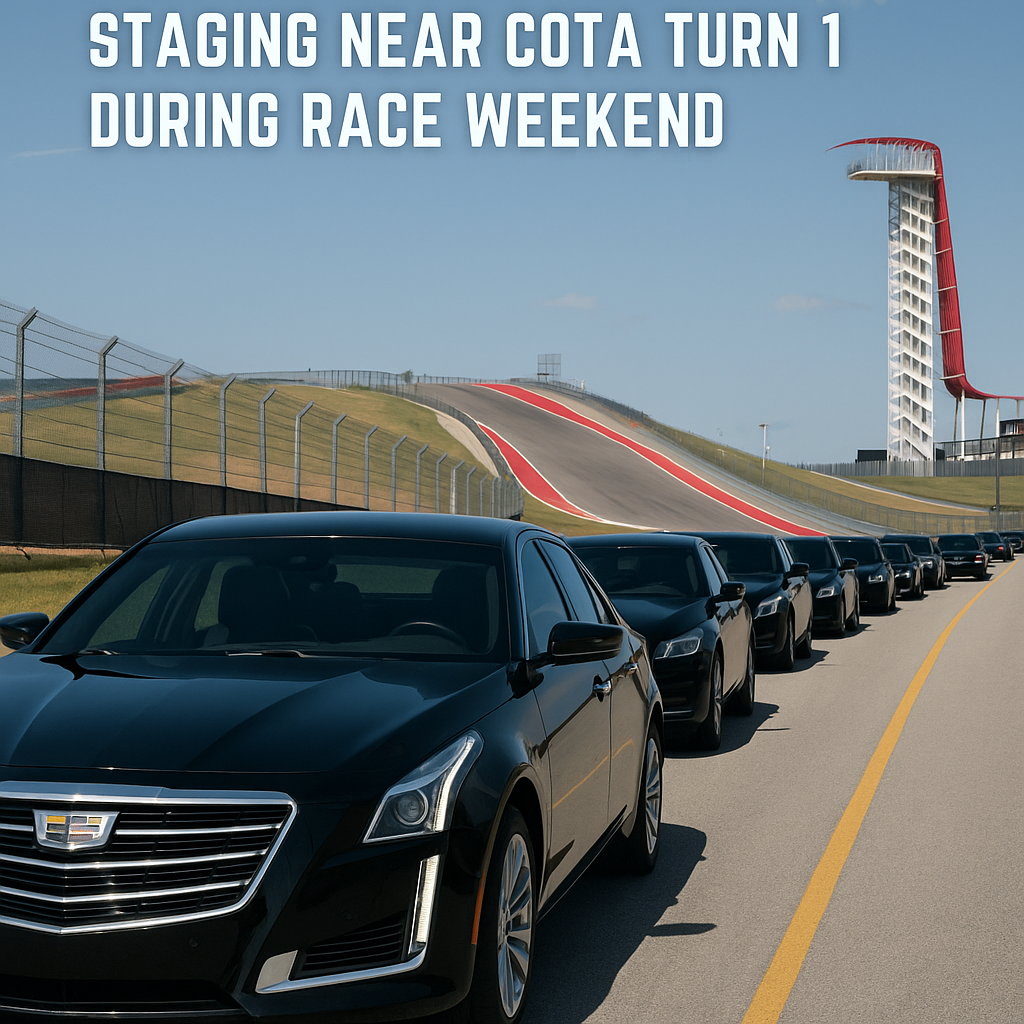
Pro Tip: Build mapped staging points near FM 812 and predefined pickup zones to cut dwell time and improve exit speed after sessions.
The Transportation Ripple Effect Across Texas
Race week produces a statewide chain reaction. Every mode—airport transfers, executive limos, sprinter vans, motorcoaches, rideshare, taxis, and even rental cars—faces a demand spike. Hotels, event venues, and concierge desks lean on vetted, licensed operators to move VIPs, creators, and crews safely and on time.
| Sector | Impact Summary |
|---|---|
| Airport Transfers | Peak arrivals strain AUS; overflow pushes to IAH/HOU, DFW/DAL, SAT, driving inter-city trips. |
| Chauffeured Limo/Black Car | VIPs, sponsors, execs demand private, punctual, premium experiences with meet-and-greet. |
| Shuttles & Coaches | Group logistics for teams, media, and hospitality; repeated hotel-to-COTA circuits. |
| Rideshare & Taxis | Surge pricing & constrained availability near sessions and concerts. |
| Rental Cars | Inventory tightens across Central Texas; chauffeured alternatives gain share. |
How Limo and Shuttle Companies Benefit
1) Surging Corporate & VIP Demand
Sponsors and global brands host activations requiring black-car reliability and NDA-level discretion. Multi-stop itineraries, late-night returns, and last-minute changes reward operators with robust dispatch and communication discipline.
2) Airport Overflow & Long-Distance Transfers
Sold-out flights and hotels push visitors into Houston, Dallas, and San Antonio. Inter-city transfers (165–200 miles) become routine, especially for VIPs and media crews that prefer door-to-door service over rental cars.
3) Premium Experience Upsells
F1 is luxury. Bundle meet-and-greet, bottled water, device chargers, Wi-Fi, and priority routing to justify higher ADRs (average daily rates). Offer weekend packages covering arrivals, practice/qualifying, race day, and departure.
Pro Tip: Publish transparent, fixed-price F1 packages. Predictability beats haggling during peak hours and helps with driver scheduling.
Economic Impact & Authoritative Sources
Austin’s Grand Prix is a repeatable tourism engine, with hospitality, food, and ground transportation among top spend categories. For schedules and official event details, see the official Formula 1 U.S. Grand Prix page and the Circuit of the Americas event hub. Local business insight and impact briefs are often summarized by the Austin Chamber.
Houston and Dallas as Feeder Cities
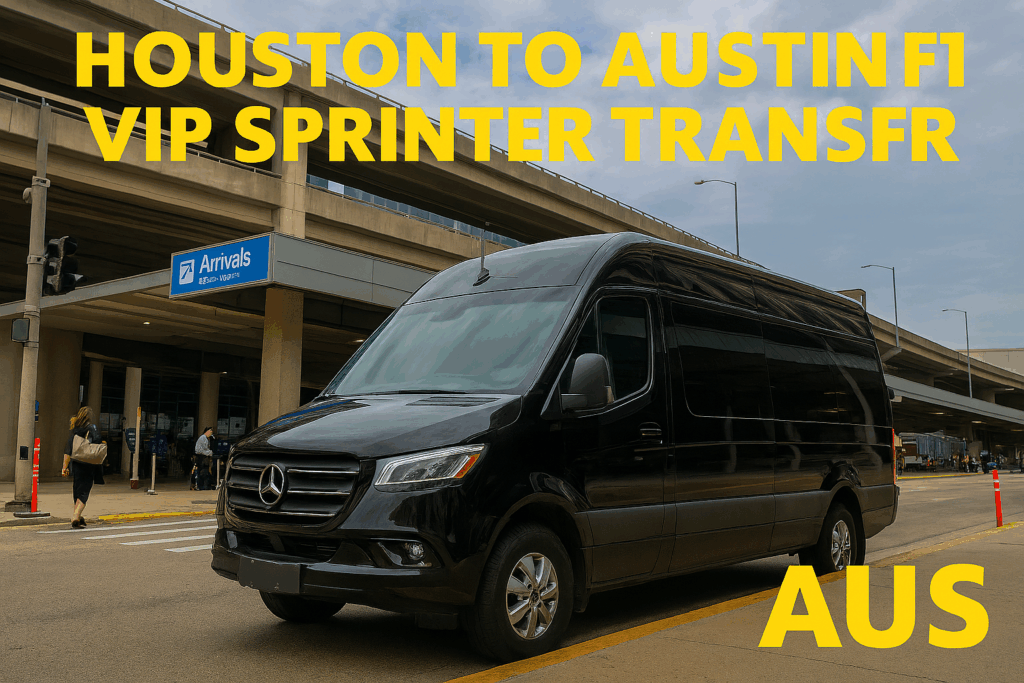
IAH/HOU (Houston) and DFW/DAL (Dallas–Fort Worth) capture international traffic when AUS maxes out. That fuels demand for executive SUVs, sprinters, and coaches running multi-hour trips to Austin and nearby towns (Round Rock, San Marcos, Bastrop).
Smart operators collaborate across metros—e.g., a Houston vendor handles arrivals and hands off to an Austin partner for daily circuits—protecting quality and uptime.
Pro Tip: Build city-pair landing pages: “Houston to Austin Grand Prix Transfers” and “DFW to COTA VIP Sprinter” to capture high-intent queries.
Hotel Overflow = Transportation Opportunity
Race-week ADRs in Austin spike, pushing visitors to Round Rock, San Marcos, Bastrop, and even Houston. That radius expansion creates daily demand for commuter shuttles and private chauffeur packages. Make it easy with simple booking flows, clear pickup windows, and SMS confirmations.
Create a dedicated page (e.g., “Round Rock to COTA Shuttle”) and add LocalBusiness + Event schema to boost AI search visibility.
Search & AI Visibility During Race Week
- Landing pages: “Austin F1 shuttle,” “U.S. Grand Prix limo service,” “Formula 1 transfers from Houston.”
- Google Business Profile: Event posts, COTA-week hours, and service areas.
- Schema: Add FAQ, LocalBusiness, and Event markup (see JSON-LD below).
- Visuals: Fleet photos with keyword-rich alt text (e.g., “Austin F1 VIP sprinter transfer”).
- AI-friendly formatting: Short paragraphs, labeled sections, clear questions and answers.
Operational Challenges to Plan For
Expect traffic congestion, restricted access, and spotty cell networks near COTA. Build extra buffer time into itineraries. Use geofenced pickup points and two-way messaging. Price for overtime and fuel volatility.
Staging & Timing Playbook
- Stage near FM 812 where compliant and permitted.
- Pre-assign Plan B/C routes for post-race exits.
- Consolidate small groups into sprinters for fewer curbside events.
- Keep a rapid-response spare vehicle for VIP schedule changes.
Beyond Austin: Statewide Impact on Mobility
Houston: High international arrivals, strong demand for SUVs and sprinters; concierge meet-and-greet at IAH is a differentiator.
Dallas–Fort Worth: Long-distance charters for fan groups and media; frequent DFW↔COTA runs.
San Antonio: Lodging overflow and day-trip shuttles to COTA with early departures and late returns.
Galveston: Some visitors extend stays for cruises; port-area limo firms capture incremental bookings.
Action Plan for Transportation Companies
- Prepare Fleets Early: Full inspections 30 days out; stock water, chargers, signage, Wi-Fi hotspots.
- Package & Price: Weekend bundles (arrivals + practice/qualifying + race + departure) with fixed pricing.
- Train & Brief: Chauffeurs rehearse routes, staging areas, and client etiquette.
- Market Smart: SEO pages + PPC for “F1 Austin transfers,” social countdowns, hotel/concierge partnerships.
- Optimize for AI-Search: Clear headings, FAQs, schema, and conversational phrasing.
Conclusion: Driving Texas Forward
The U.S. Grand Prix in Austin is a catalyst for Texas mobility. With disciplined planning, premium service design, and event-focused marketing, transportation companies convert a complex weekend into a brand-building, high-profit showcase. As F1 expands its U.S. presence, Texas remains a cornerstone—and its transportation providers are the engines that keep it all moving.
FAQs
1- How does the U.S. Grand Prix in Austin impact local transportation?
The race attracts hundreds of thousands of visitors, overwhelming local capacity and boosting demand for airport transfers, limos, shuttles, and ride-hail across the region. Many operators report their highest-earning week during the event.
2- Which Texas cities benefit most from the Grand Prix?
Besides Austin, Houston, Dallas–Fort Worth, and San Antonio see major gains from lodging overflow and international arrivals, driving inter-city transfers and multi-day chauffeur packages.
3- How can transportation companies prepare for the Grand Prix?
Plan early: expand fleets, secure standby drivers, create fixed-price weekend bundles, and publish event-specific pages with FAQs and schema. Partner with hotels and event planners, and pre-map staging areas near COTA for faster turnarounds.
4- Did Houston limousine companies get business from the U.S. Grand Prix in Austin in 2025?
Yes — many Houston-based limousine operators saw a strong surge in bookings during the 2025 Formula 1 U.S. Grand Prix in Austin. Demand for VIP transfers, corporate shuttles, and executive transportation rose sharply as fans, sponsors, and business travelers moved between Houston and Austin. The Houston Limousine Association had already prepared its members well in advance, coordinating strategies and logistics through meetings and updates since 2021. For many companies, it turned into a record-breaking revenue weekend and a true showcase of Texas hospitality and professional chauffeur service.